If there is one moment that defines the raw, untamed spirit of Iceland, it’s the split second before an eruption at the Geysir Geothermal Area. You stand among a hushed circle of travelers, eyes locked on a deceptively calm pool of turquoise water. Suddenly, the water swells into a brilliant blue dome, a low "thwack" echoes through the Haukadalur Valley, and a tower of boiling water sky-rockets 30 meters into the air.
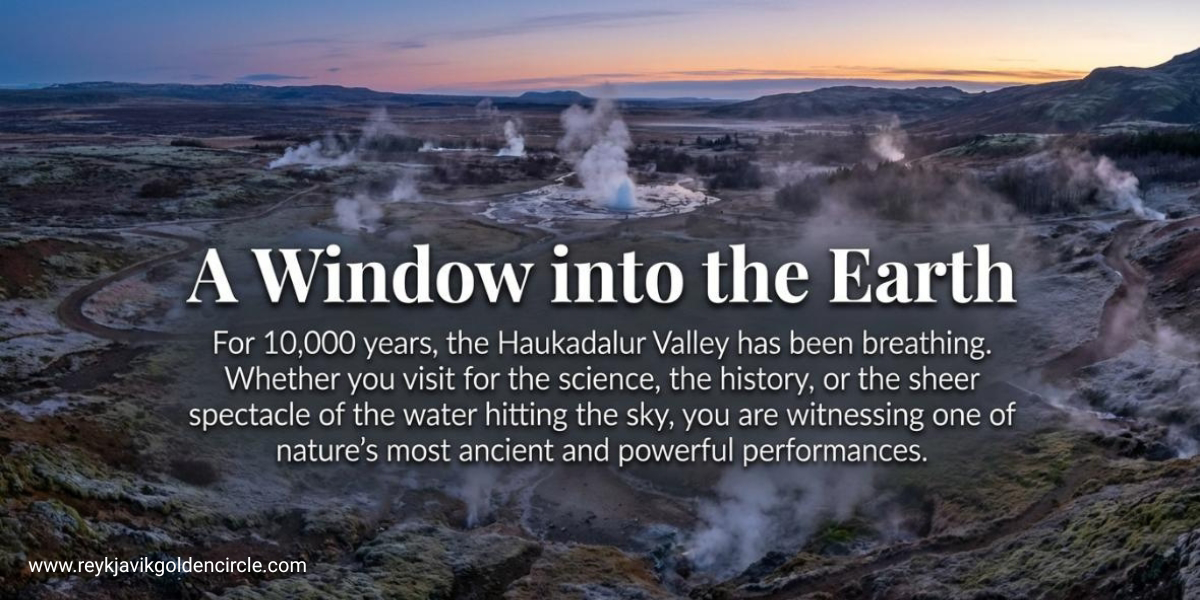
This spectacular display is why Geysir is a headline stop on the famous Reykjavik Golden Circle. It’s more than just a photo opportunity; it’s a place where you can feel the Earth’s frantic pulse beneath your boots. For over 10,000 years, the Haukadalur Valley has been breathing, offering a window into the powerful forces that shape our planet.
What Is the Geysir Geothermal Area?
The Haukadalur Valley is home to a world-famous family of geothermal features. While many tourists come for the "show," the area's history is deeply rooted in the landscape. Written accounts of spouting hot springs here go back as far as 1294, shortly after a set of powerful earthquakes reshaped the valley's plumbing.
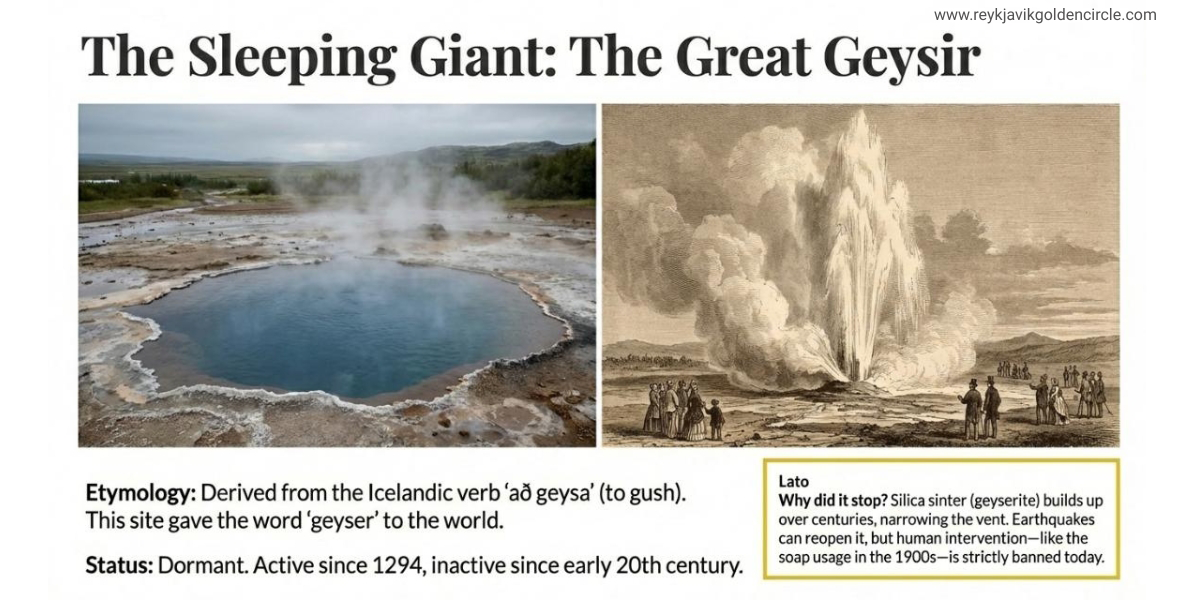
This area is the birthplace of the word "geyser" itself, derived from the Icelandic verb geysa (to gush). This etymology traces back to the "Great Geysir," the majestic titan that gave its name to all other geysers worldwide.
Over time, silica sinter (geyserite) built up and narrowed the Great Geysir's vent. The process was accelerated in the early 20th century, when people used soap to trigger artificial eruptions — a practice strictly banned today to protect these fragile geothermal systems.
The Geology: Why the Ground Here Erupts
The Haukadalur Valley sits on a geothermal system active for roughly 10,000 years. The 3 km² volcanic system lies mainly to the west, beneath the rhyolitic Laugarfjall lava dome — though it hasn't produced a volcanic eruption in all that time. The heat is there. The lava simply isn't.
The mechanics are simpler than they look. Groundwater — possibly from the southern Langjökull ice sheet some 50 km north — seeps deep underground, where hot rock heats it well past boiling point. It can't actually boil, because the weight of the water column above holds it under immense pressure. When conditions tip, the superheated water flashes to steam, expands explosively, and launches everything above it skyward.
Thermal mapping has identified 364 distinct hot areas across the valley. The sulfur smell, the warm earth underfoot, the steam drifting from cracks in the rock — none of it is staged.
The Great Geysir: The Original
Fifty metres north of Strokkur sits its legendary neighbour, the spring that gave its name to every geyser on Earth.
A 10,000-Year History
Silica sinter deposits around the vent show hot springs have been active at this exact spot for roughly 10,000 years. Saxo Grammaticus described a geyser at the site around 1206, and the earliest firm reference appears around 1294, when earthquakes created new springs in the valley. The modern geyser became active around 1150 CE.
At its peak it was staggering. In 1845 it reportedly hurled boiling water 170 metres (558 feet) into the air, and in the early 1900s visitors could watch it erupt every 30 minutes. Its pool measures 18 metres (60 feet) across and about 1.2 metres deep when quiet.
Why It Stopped
Geysir has always been temperamental, cycling between active and dormant phases triggered by seismic events. A major earthquake in 1896 boosted its activity, but eruptions grew less frequent and the Great Geysir fell essentially silent by 1916. The June 2000 earthquake temporarily reawakened it for several years, with its last notable eruption recorded in 2016.
You can walk right up to the pool — it's clearly marked. A large, still, steaming basin ringed by white and gold mineral deposits, sitting in silence while Strokkur explodes nearby every few minutes. That contrast, the ancient giant sleeping beside the tireless performer, is one of the area's most compelling features.
Other Experiences You Might Enjoy
Most visitors see Geysir as one stop on a longer day out. It's easy to combine with the rest of the Golden Circle — Þingvellir and Gullfoss — or extend the day with a soak at the Secret Lagoon or Blue Lagoon before heading back to Reykjavik. Browse top-rated experiences that pair well with a visit to Geysir:
Strokkur: The Reliable Performer
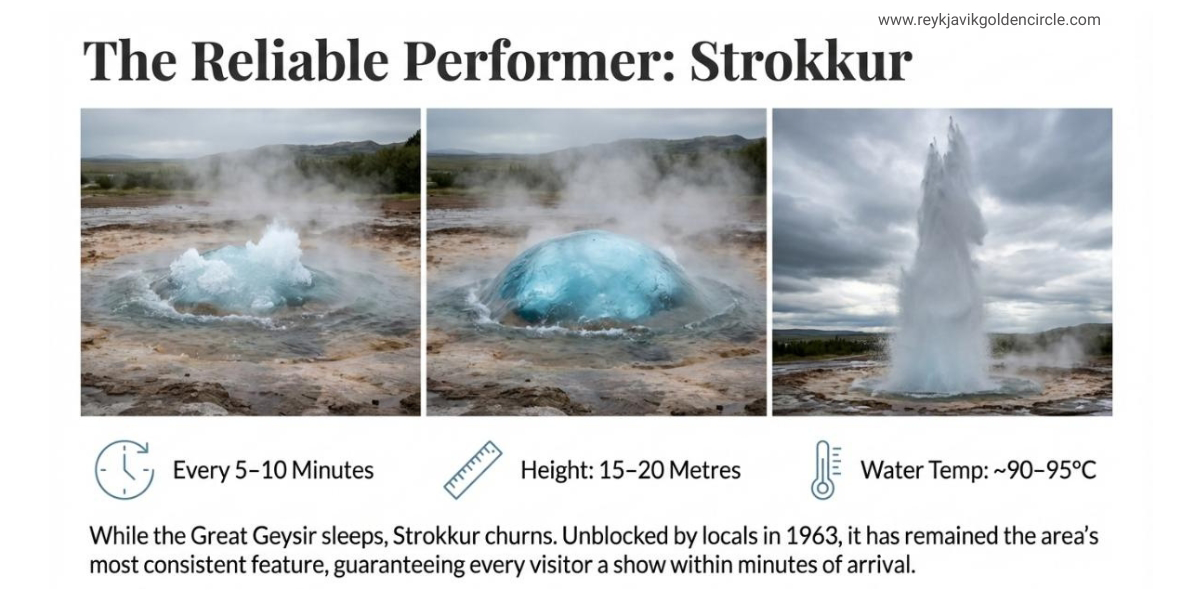
Because the Great Geysir has retired from the public eye, the modern spectacle is provided by its neighbor, Strokkur. Known as the most reliable geyser on the planet, Strokkur ensures that every visitor sees a show within minutes of arrival.
The Numbers
| Measure | Strokkur |
|---|---|
| Eruption interval | Every 5–10 minutes (average around 6–7 minutes) |
| Typical height | 15–20 metres (49–66 feet) |
| Maximum recorded height | Up to 40 metres (131 feet); 1815 accounts estimate 60 metres |
| Surface water temperature | Near boiling, around 95°C (203°F) |
| Pool diameter | About 12 metres across |
| Conduit depth | Over 20 metres — narrowing at 8 m, opening into a cavity at 11 m, then narrowing again into a fracture at 13 m |
A 2020 study in Geophysical Research Letters catalogued 73,466 eruptions from one year of seismic monitoring, finding Strokkur fires single eruptions most of the time but occasionally double, triple or even sextuple bursts in succession — after a single the average wait is 3.7 minutes, after a sextuple about 16.4. A 2025 study in Scientific Reports tracked 650,000 eruptions over 4.5 years and found wind speed the biggest external factor in timing.
What It Looks Like in Real Time
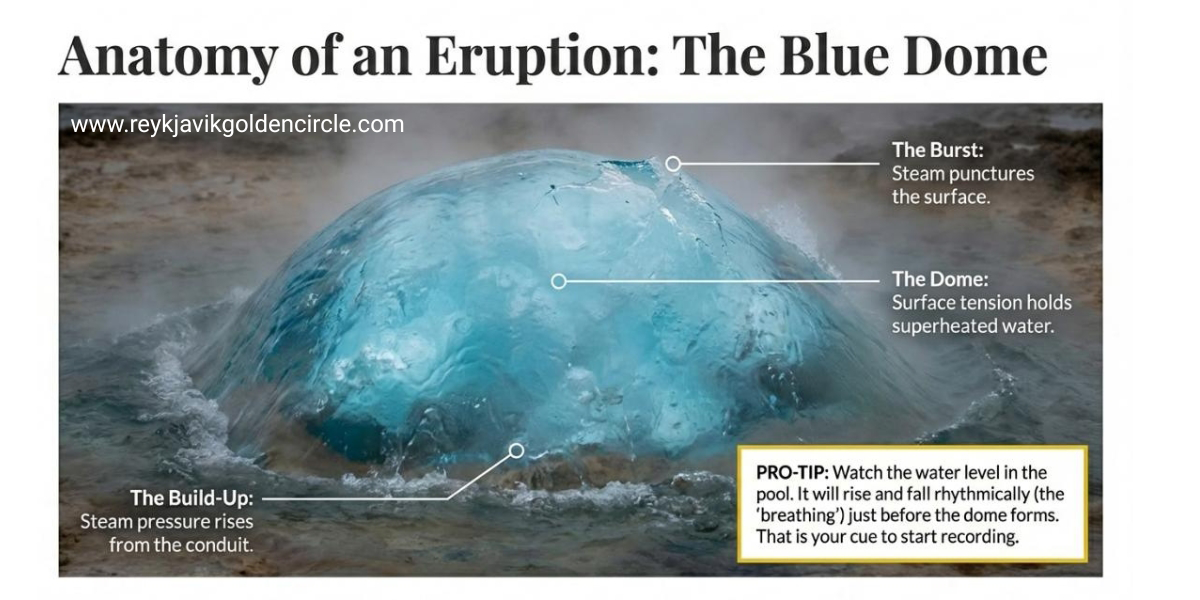
- The pool sits quietly. Turquoise water fills the basin and steam rises gently.
- The water pulses. A rhythmic swelling and sinking, as boiling water rises in the conduit and settles back as steam escapes.
- The dome forms. The surface bulges into a brilliant blue hemisphere of transparent, superheated water stretched thin.
- The eruption. The dome bursts and a column rockets upward — sometimes vertical, sometimes blown sideways by wind. The active phase lasts 3–5 seconds, with steam lingering another 10–15.
- The reset. Water drains back, the pool calms, and the cycle begins again.
Watch the water level carefully. It rises and falls rhythmically — a behaviour known as "breathing" — just before the dome forms. That is your cue to start recording.
Strokkur's History
Strokkur — Icelandic for "churn" — was first mentioned in writing in 1789, when an earthquake unblocked its conduit. Its activity fluctuated through the 19th century before another earthquake sealed the conduit around 1900, silencing it for decades. In 1963, on the recommendation of the Geysir Committee, locals cleared the blockage by drilling through the bottom of the basin. It has erupted reliably ever since.
Since 19 October 2024, the Icelandic Met Office has reported an unusual increase in geothermal activity across the area. Strokkur and several smaller hot springs have been erupting more frequently and more powerfully, with steam columns reaching up to 30 metres. Follow posted safety guidance and stay within the marked areas.
Beyond the Plume: Hidden Gems
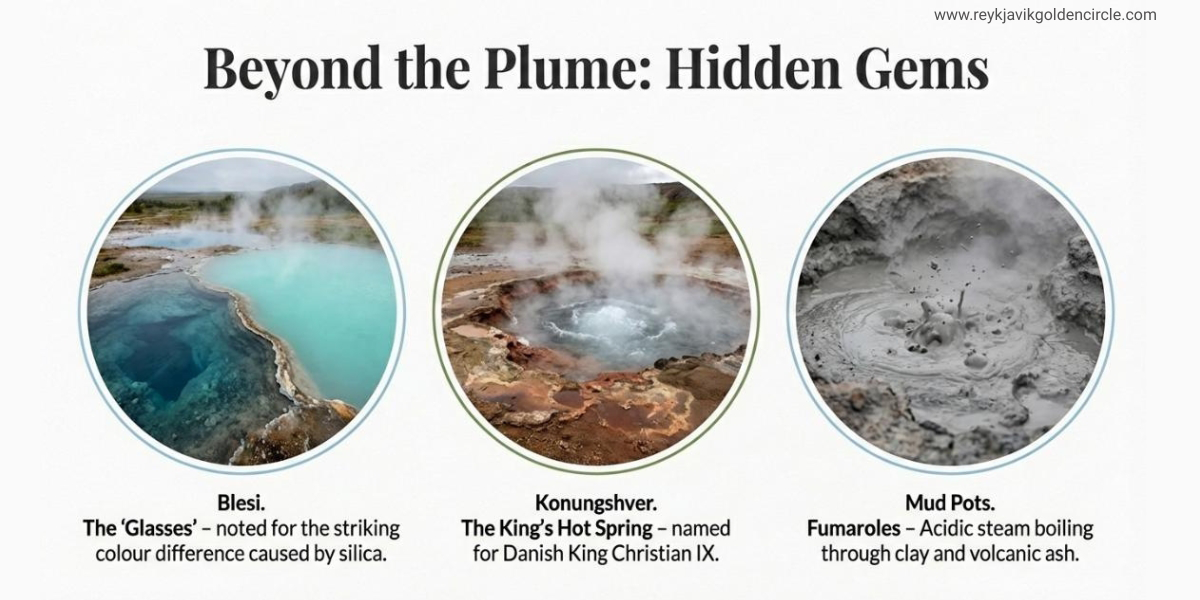
Even if you arrive just for the geyser, the Haukadalur Valley holds several other geothermal treasures worth exploring along its marked paths:
| Feature | What to look for |
|---|---|
| Blesi | A pair of connected pools near the main path — one milky blue-white, one crystal clear and near boiling. The difference comes down to silica content and depth. After Strokkur, the most photographed feature here. |
| Litli-Strokkur | "Little Strokkur" bubbles and splashes continuously, occasionally managing modest eruptions of a metre or two — a charming miniature of its famous neighbour. |
| Smiður | Another small geyser, named for the Icelandic word for "craftsman." Like Litli-Strokkur it produces smaller bursts, adding to the sense that the whole hillside is alive. |
| Konungshver | The "King's Hot Spring," named for Danish King Christian IX's visit in 1874, sits higher on the Laugarfjall hillside, its colours shifting between blue, green and orange. Nearby rocks where the king reportedly watched eggs boiled in the springs are still called Konungssteinar, "the King's Stones." |
Fumaroles and Mud Pots
Scattered across the hillside, these steaming vents and bubbling mud pools are the less glamorous but more intimate face of geothermal activity. The mud pots make wet, plopping sounds; the fumaroles hiss and steam. They concentrate toward the southern end of the field at Þykkuhverir, where mineral deposits stain the ground yellow with sulfur, green with copper and red with iron.
The Laugarfjall Hillside Walk
A short trail climbs the slope behind the geothermal area for an elevated view over the whole valley — steam rising from dozens of points, the green landscape stretching toward the distant Langjökull glacier. On a clear day it's one of the best viewpoints on the Golden Circle, and almost nobody walks up. With more time, a 4.7 km loop trail circles past Haukadalur church and the quieter countryside beyond, taking about 80 minutes.
Why Geysir Anchors the Golden Circle Route
The Golden Circle route from Reykjavik is the classic Iceland introduction. It packs three major sights into a single loop, and Geysir serves as the middle point of this legendary circuit.
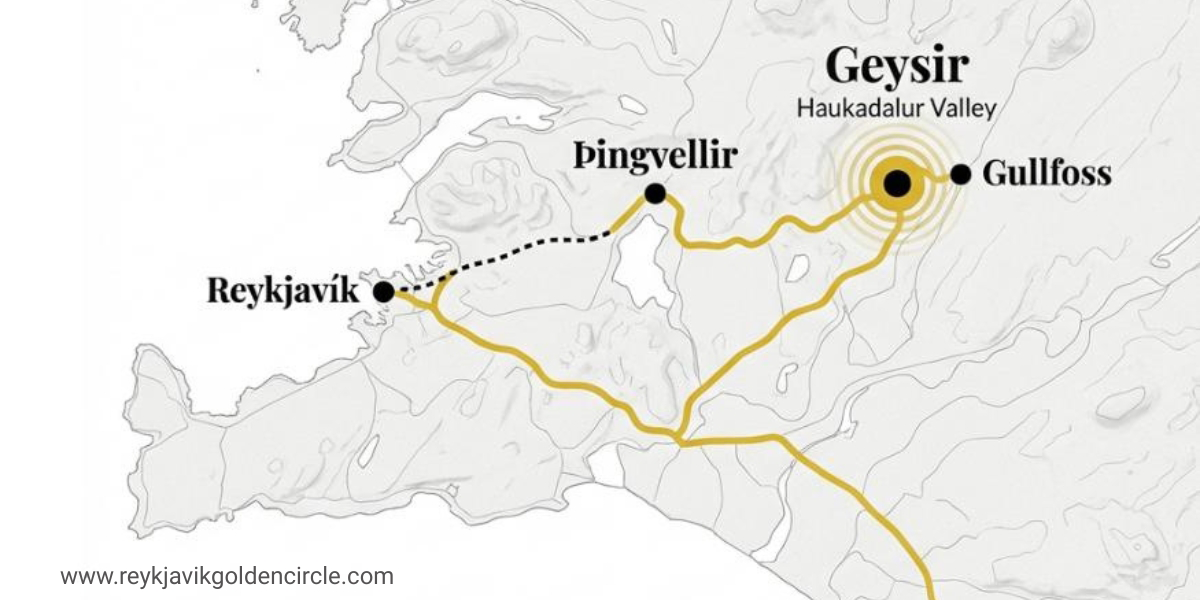
As part of a Golden Circle day trip from Reykjavik, most travelers visit in this order:
- Thingvellir National Park: Where the continents pull apart.
- Geysir Geothermal Area: Where the earth "breathes" and erupts.
- Gullfoss Waterfall: The thundering power of the Hvítá river.
How to Visit
Reaching the Iceland geysers near Reykjavik is straightforward and takes about 1 hour and 30 minutes of driving from the capital.
Self-Drive vs. Reykjavik Golden Circle Tour
- Self-Drive: Perfect for those who want to set their own pace and perhaps wait for several Strokkur cycles.
- Reykjavik Golden Circle Day Tour: The easiest way to visit. A Reykjavik Golden Circle tour takes the stress out of driving and provides expert commentary on the geology you're seeing.
Practical Information at a Glance
| Detail | What to know |
|---|---|
| Location | Haukadalur Valley, about 100 km (62 miles) from Reykjavík — roughly a 1.5-hour drive via Route 1 east then Route 35 north |
| Entrance fee | Free. The geothermal area is an open natural site with no admission charge |
| Parking | 1,000 ISK per vehicle, payable via the Parka app. Maximum 8 hours; under 15 minutes is free |
| Hours | The geothermal area is open 24 hours a day, year-round. The Geysir Center typically runs 10:00–19:00, with shorter hours in winter |
| How long to spend | 45 minutes to 1.5 hours is typical |
| Neighbouring stops | Gullfoss is 10 minutes east; Þingvellir National Park is 50 minutes west |
In 45 minutes you can watch four to six eruptions, walk past Geysir, see Blesi and loop back. With 1.5 hours you can explore the full hillside, walk up to the Laugarfjall viewpoint and still have lunch. Note that paid parking only arrived in late 2024 — older guidebooks describing it as free are out of date.
Food and Facilities
The Geysir Center houses a food-court-style restaurant serving Icelandic staples — lamb soup, fish stew, sandwiches, pastries and coffee — plus restrooms and a large gift shop. Convenient and reasonably priced by Icelandic standards. The Hotel Geysir restaurant across the road is the more upscale sit-down option, and 25 minutes west Friðheimar serves an entire meal grown inside a working geothermally heated tomato greenhouse. Reservations essential.
Geysir is busiest from roughly 10:00 to 15:00, when the tour buses arrive. Early morning or evening — easy in summer's long daylight — gives you a quieter field and a clear view of each eruption. If you're staying at Hotel Geysir across the road, visiting at dawn or after dark in winter, with steam lit by low-angle light or aurora, is something most day-trippers miss entirely.
Capturing the Moment: Photography Guide
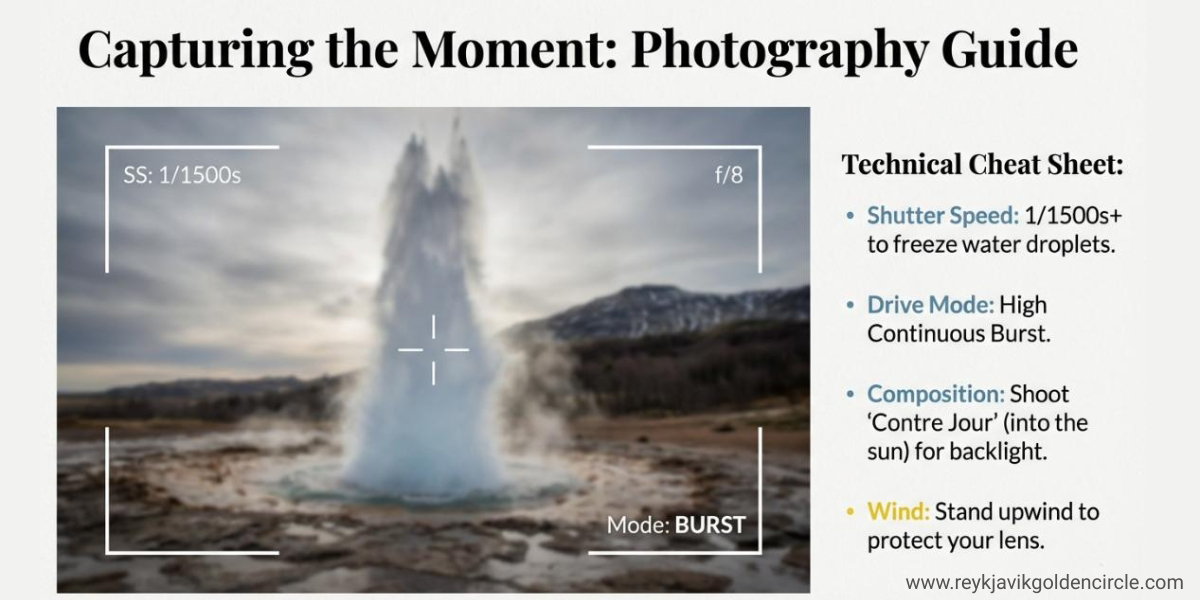
To "freeze" the water droplets and that iconic blue bubble, you'll need the right camera settings. A fast shutter speed of 1/1500s or higher is essential. Use a high continuous burst mode to ensure you don't miss the peak of the eruption.
A Destination for All Seasons
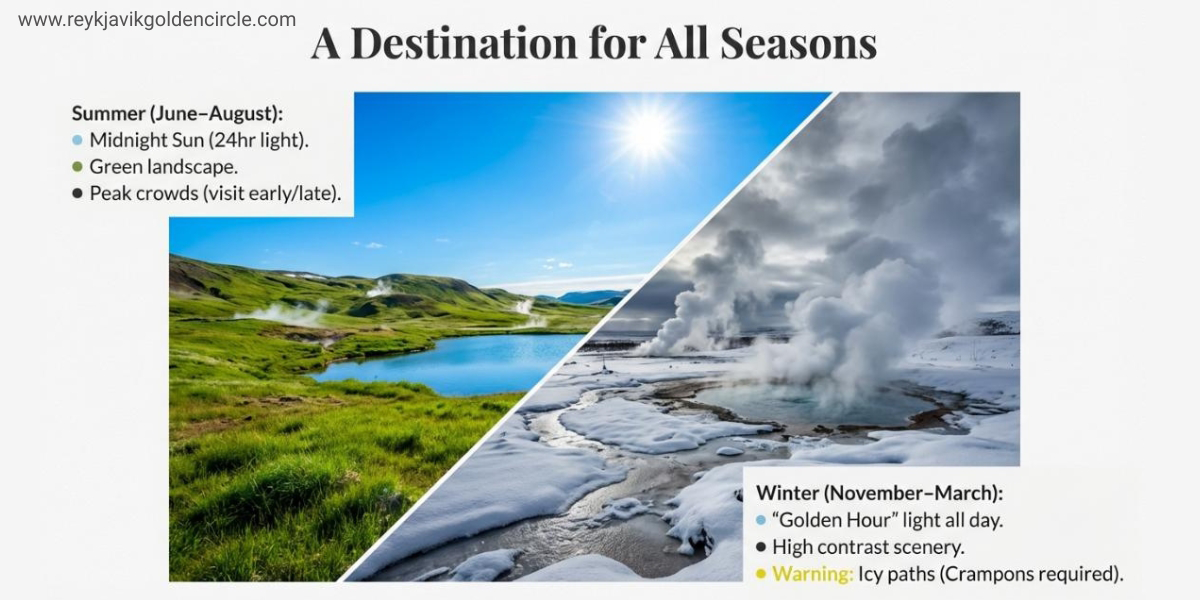
Whether you visit in the endless light of the Midnight Sun (June–August) or the high-contrast snowy landscapes of **Winter** (November–March), the area is striking year-round. Note that winter visits require extra preparation, as spray from the geyser can turn paths into treacherous ice rinks.
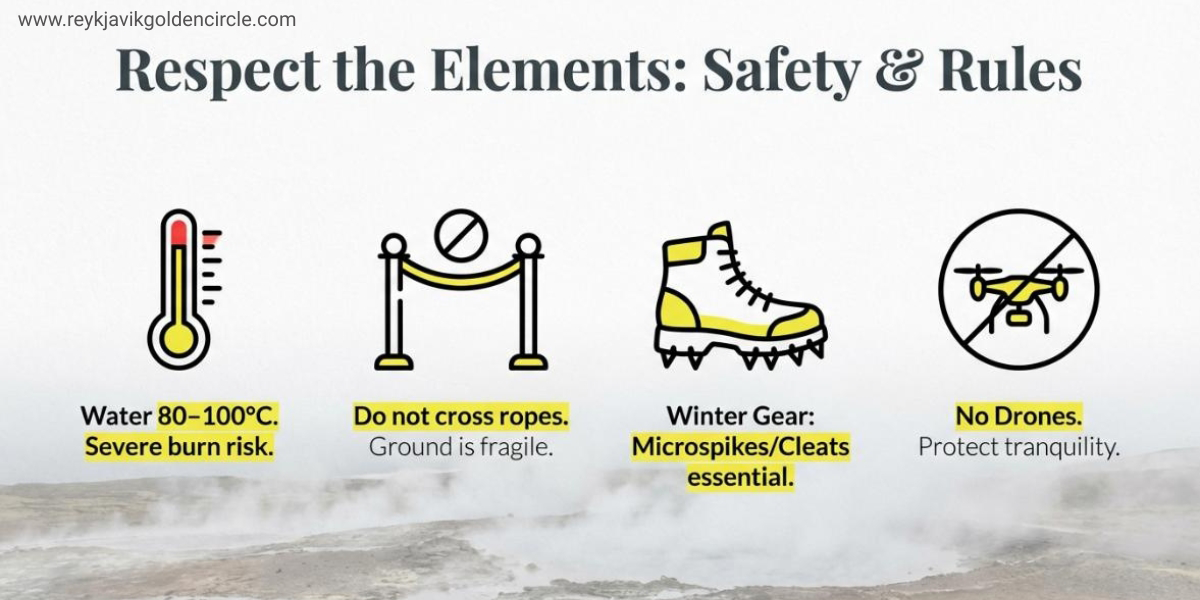
Respect the Elements: Safety & Rules
The ground here is a living, breathing engine. For your safety and the preservation of this UNESCO-adjacent wonder, please follow these rules:
- Stay behind the ropes: Geothermal ground can have thin crusts.
- Water is 80–100°C: Severe burn risk if touched.
- No Drones: Help protect the tranquility of the valley.
- Winter Gear: Microspikes or cleats are essential for the icy paths between October and April.
- Stand upwind: In windy conditions Strokkur's spray blows sideways toward spectators. Position yourself upwind where you can, and keep cameras protected — the mineral-laden water isn't kind to lenses.
The Science of Geyser Naming
Every geyser on Earth — Old Faithful, the geysers of Yellowstone, the Waimangu system in New Zealand — is named after this hot spring in this Icelandic valley. The word entered English from Icelandic, derived from geysa, "to gush," because European naturalists travelling in Iceland during the 18th and 19th centuries wrote about "the Geysir" until the name became the generic term for any periodically erupting hot spring.
Geysir was the first such spring described in European literature, appearing in writing as early as 1206 and documented consistently from the late 13th century onward. So when you stand at its pool — silent and dormant though it is — you are at the place that named the phenomenon.
Nearby Attractions
Don't stop at Geysir. The valley sits in the heart of the Golden Circle, so almost everything worth seeing is minutes away:
- Gullfoss Waterfall — 10 km east (10 minutes). A two-tier cascade dropping 32 metres into a dramatic canyon. Free parking.
- Þingvellir National Park — 60 km west (50 minutes). UNESCO site, tectonic plate boundary and home of the Alþingi parliament. Parking 1,000 ISK.
- Kerið Volcanic Crater — 40 km south (35 minutes). A vivid red-walled crater lake. Entry 600 ISK.
- Friðheimar Greenhouse — 25 km west (25 minutes). Geothermal tomato farm and restaurant. Reservations required.
- Secret Lagoon (Gamla Laugin) — 25 km south in Flúðir (20 minutes). Iceland's oldest swimming pool, 38–40°C, cheaper and less crowded than the Blue Lagoon.
- Laugarás Lagoon — 20 km northwest (15 minutes). Iceland's newest geothermal retreat, opened late 2025.
- Brúarfoss — 20 km west (20 minutes). "Iceland's bluest waterfall," on the Brúará river. Parking via the Parka app.
Frequently Asked Questions
Commonly every 5-10 minutes, making it very reliable for travelers.
It is currently dormant, though it still occasionally erupts after large earthquakes.
No, admission to the geothermal area is free. You only pay for parking.
Yes, it is a very easy and popular self-drive destination.
Most tours last between 8 and 10 hours for the full loop.
The main path from the parking area to Strokkur is paved and relatively flat, making it accessible for wheelchairs and strollers. The paths leading further up the hillside to the fumaroles and the Laugarfjall viewpoint are rougher and steeper.
Old Faithful in Yellowstone erupts every 60–110 minutes and reaches 30–55 metres. Strokkur erupts every 5–10 minutes and reaches 15–20 metres, occasionally up to 40. Strokkur is smaller but erupts roughly ten times more often, so you are almost guaranteed to see it.