Þingvellir National Park is the single most important stop on Iceland's Golden Circle — a UNESCO World Heritage Site where you can walk through a visible continental rift, stand where the world's oldest surviving parliament was founded in 930 AD, and snorkel in some of the clearest water on Earth. This guide goes deep on Þingvellir specifically: its history, its geology, the Silfra fissure, and everything you need to plan your visit.
If you've read our Complete Golden Circle Guide, you already know that Þingvellir (often anglicized as Thingvellir) is the first of the three classic stops on the route, alongside Geysir and Gullfoss. This article is the deep dive — everything that makes Þingvellir worth far more than a quick photo stop.
Most visitors see Þingvellir as the first stop on a full-day Golden Circle tour. If that's your plan, the route's most popular day trip is an easy place to start:
Reykjavik: Golden Circle Full-Day Tour with Kerid Crater
Visit Þingvellir, Geysir and Gullfoss — plus Kerið crater — by air-conditioned bus from Reykjavik, with hotel pickup and a local guide to bring the history to life.
- Walk the rift valley at Þingvellir
- Strokkur geyser and the Gullfoss waterfall
- The Kerið volcanic crater lake
A Quick Overview
Þingvellir National Park sits in a rift valley about 45 km northeast of Reykjavik, where Iceland's history and geology meet in one dramatic landscape. It is, at the same time: the founding site of Icelandic democracy, a UNESCO World Heritage Site, one of the very few places on the planet where you can see a continental rift above sea level, and the location of one of the best snorkeling and diving sites in the world. Few national parks anywhere combine this much historical weight with this much natural drama.
The History of Þingvellir: Birthplace of a Nation
The Althing — the world's oldest surviving parliament
In 930 AD, Iceland's Viking-age chieftains gathered at Þingvellir and founded the Alþingi (Althing), an open-air general assembly that represented the whole country. The name Þingvellir itself means "Assembly Plains." For roughly two weeks each summer, free men from across Iceland travelled here to set laws, settle disputes, and conduct the business of a young, scattered society — making the Althing one of the oldest parliamentary institutions in the world.
At the heart of the assembly stood Lögberg, the Law Rock. Each year, an elected Lawspeaker (Lögsögumaður) would stand here and recite the entirety of Iceland's law from memory to the gathered crowd, since the laws were not yet written down. The exact location of the rock has been debated by historians, but the most likely spot is marked today with a flag.
Þingvellir witnessed some of the most consequential moments in Icelandic history. In the year 1000, the Althing peacefully voted to adopt Christianity as the national religion, avoiding civil war between Iceland's Christian and pagan factions. The assembly continued to meet here nearly every year until 1798.
From national park to the birth of a republic
In 1928, Icelandic law placed Þingvellir under the protection of the Althing itself, and in 1930 — the 1,000th anniversary of the assembly's founding — it was formally declared Iceland's first national park. Then, on June 17, 1944, Þingvellir hosted the ceremony at which Iceland formally declared independence from Denmark and founded the modern Republic of Iceland, deliberately tying the new nation to its thousand-year-old democratic roots.
UNESCO World Heritage Status
In 2004, UNESCO inscribed Þingvellir National Park as a World Heritage Site. The designation recognizes the site's outstanding cultural value: the remains of roughly fifty turf-and-stone assembly booths still visible across the plain, the largely unchanged cultural landscape shaped by over a thousand years of use, and the site's deep symbolic association with the development of governance and the rule of law. It is a rare honour for a site to qualify on cultural grounds alone, but Þingvellir's natural setting — the rift valley itself — is inseparable from the story.
Worth Adding to Your Itinerary
Þingvellir is the gateway to the rest of the Golden Circle — most visitors continue to Geysir and Gullfoss the same day. It's also the home of Silfra snorkelling, and pairs naturally with a Secret Lagoon or Blue Lagoon soak, glacier snowmobiling on Langjökull, a South Coast day trip, or a winter Northern Lights hunt from Reykjavik. Browse top-rated experiences that pair well with Þingvellir:
The Geology: Walking Between Two Continents
Þingvellir sits directly on the Mid-Atlantic Ridge, the boundary where the North American and Eurasian tectonic plates are slowly pulling apart. This is one of only a handful of places on Earth where that divergent plate boundary is visible above water rather than hidden beneath the ocean.
The plates separate at a rate of roughly 2 centimetres a year — only a little faster than a fingernail grows — but that slow drift adds up. The valley floor has subsided by an estimated 3 to 4 metres since the Althing was first founded here, and the tension between the plates periodically releases in earthquakes that crack the surrounding lava fields into new fissures.
The most dramatic visible result is the Almannagjá gorge, a long basalt canyon that marks the edge of the North American plate. A boardwalk leads down into the gorge from the Hakið visitor centre, putting you literally inside the rift — towering rock walls on either side, with interpretive panels explaining the geology along the way. It's the most accessible place in the park to stand between two continents.
Silfra Fissure: Snorkeling and Diving Between Continents
No feature at Þingvellir draws more global attention than the Silfra fissure — a narrow, water-filled crack in the rift valley that opened up during a major earthquake in 1789 and has been widening by about 2 cm a year ever since.
What makes Silfra extraordinary is its water. It originates as meltwater from the Langjökull glacier, roughly 50 km away, and spends an estimated 30 to 100 years travelling underground through porous lava rock before emerging at Silfra's springs. That decades-long natural filtration leaves the water exceptionally pure, with visibility often exceeding 100 metres (328 ft) — among the clearest water anywhere on the planet. The temperature stays a constant 2–4°C (35–39°F) all year round.
Snorkeling Silfra doesn't require any diving certification — guides fit you with a drysuit, thermal layers and a mask, and a gentle current carries you through the fissure's main sections (often nicknamed the Crack, the Cathedral, and the Lagoon) for roughly 30–40 minutes in the water, with the full experience taking about 2.5 to 3 hours. Because Silfra lies within a protected national park, access is restricted to licensed tour operators, both to protect the fragile algae and rock formations and to ensure safety in near-freezing water. Booking ahead is strongly recommended, particularly in summer.
Silfra: Snorkeling Tour Between Tectonic Plates
Float between the North American and Eurasian plates in Silfra's crystal-clear glacial water — drysuit, thermals and guide included. No diving certification needed.
- Snorkel the crystal-clear Silfra fissure
- Drift between two continents in glacial meltwater
- Inside Þingvellir National Park
For the full breakdown of Silfra snorkeling and diving, see our dedicated Silfra snorkeling at Þingvellir guide.
Other Things to See and Do at Þingvellir
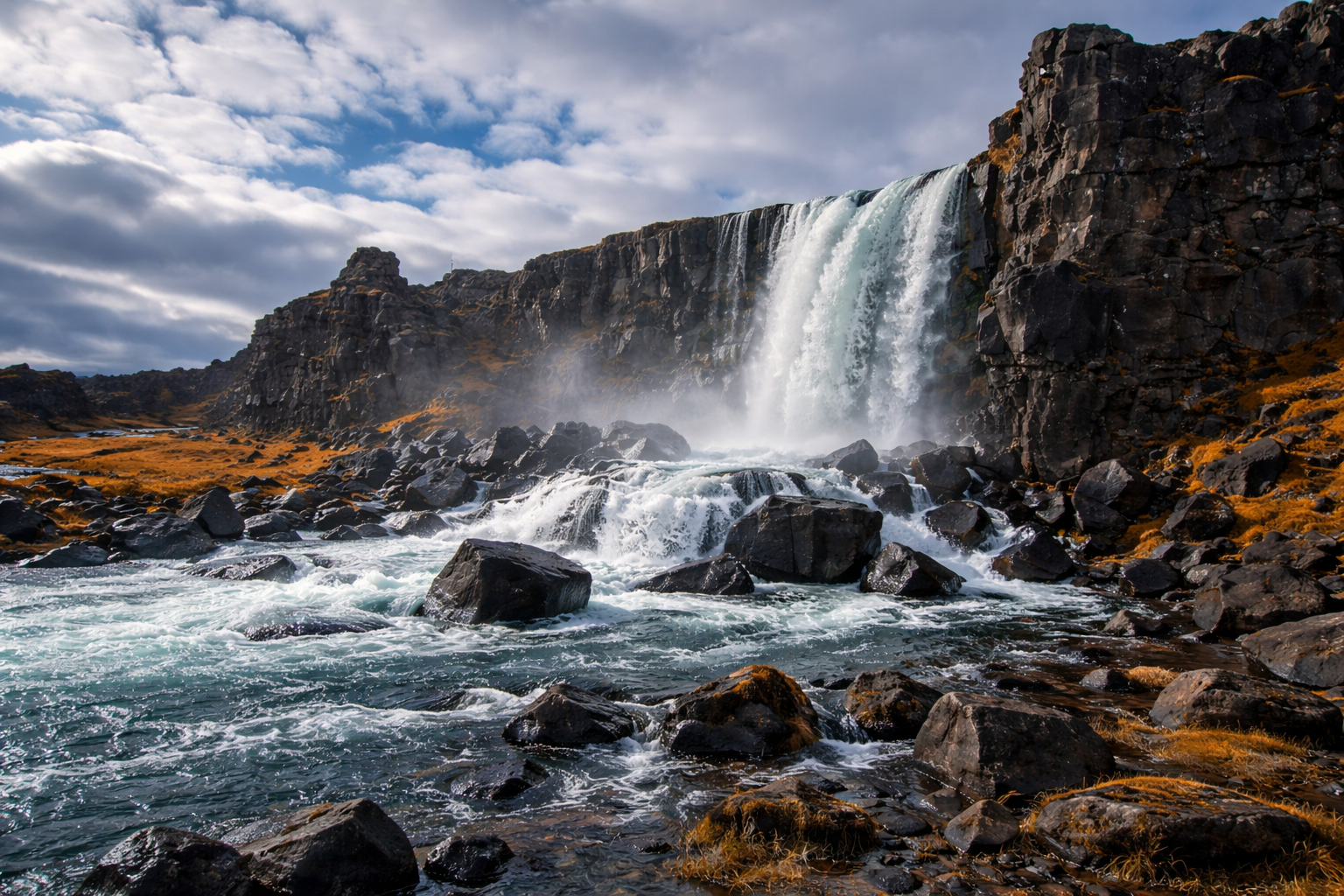
- Öxarárfoss waterfall — A compact but striking waterfall tucked inside the Almannagjá gorge, where the Öxará river drops over a dark basalt ledge.
- Þingvallavatn — Iceland's largest natural lake, formed roughly 12,000 years ago. Its cold, isolated waters are home to four distinct forms of Arctic char that evolved separately within the lake.
- Þingvallakirkja — A small white-and-black wooden church on the lake's edge, built in 1859 on the site of one of Iceland's earliest churches, with an adjoining cemetery.
- Peningagjá ("Money Rift") — A clear, water-filled fissure near the church where visitors traditionally toss coins for good luck.
- Hiking and birdwatching — Marked trails connect the main sights and continue along the lakeshore, where summer birdlife includes golden plover and whooper swans.
- Photography — The Almannagjá viewpoint from Hakið, looking down across the gorge to the lake, is the park's signature shot; the church and lake combination is another favourite in soft early-morning light.
Practical Visitor Information
Getting there: From Reykjavik, take Route 1 north and then Route 36 east. The drive covers roughly 45–50 km and takes about 45 minutes to an hour. Public transport options are limited, so most visitors arrive either in a rental car or on a guided tour.
Entrance and parking fees: There is no charge to enter Þingvellir National Park itself. Parking, however, is paid at the main lots (P1 near the visitor centre, plus P2 and P5 elsewhere in the park), payable via the Parka app or on-site machines, and one ticket typically covers parking across the park's lots for the day. The Hakið visitor centre's interactive exhibition carries its own small admission fee; the outdoor park and trails are free once you've paid for parking. (See our parking fees guide.)
Opening hours: The park itself is open year-round, day and night, since it's an open landscape rather than a gated site — though the visitor centre, café and exhibition keep set hours, generally longer in summer (roughly 9am–6pm, June through August) and shorter in winter.
Facilities: The Hakið visitor centre has restrooms, an information desk, and a café; a smaller service centre elsewhere in the park offers trail maps and road condition updates.
What to wear and bring: Sturdy, waterproof footwear with good grip is essential — the boardwalks and gravel paths can be uneven, and in winter they're often icy, so pack traction cleats if you're visiting between roughly October and April. Bring layers and a windproof jacket; the gorge can funnel surprisingly strong gusts. Our what to wear packing list has the full checklist.
Accessibility: The main Hakið viewpoint and the boardwalk into Almannagjá are relatively level and manageable for most visitors, though some sections of trail beyond the core path are uneven, gravel, or include steps.
A Simple Self-Guided Walking Route
For a first-time visit on your own, this loop covers the highlights in roughly 1 to 2 hours at a relaxed pace:
- Start at Hakið Visitor Centre for the panoramic overlook across the rift valley and Þingvallavatn lake.
- Walk down the boardwalk into Almannagjá gorge, reading the interpretive panels as you go.
- Stop at Lögberg (Law Rock), marked with a flag, where the Lawspeaker once addressed the nation.
- Continue to Öxarárfoss waterfall, a short walk further into the gorge.
- Finish at Þingvallakirkja church and the Þingvallavatn shoreline, near parking area P5 — also the meeting point if you've booked a Silfra snorkeling tour.
Visit Þingvellir on a Guided Golden Circle Tour
The easiest way to experience Þingvellir properly — along with Geysir and Gullfoss on the same day — is with a knowledgeable local guide who can bring the history to life and handle the driving, parking and logistics. For a more personal trip, this top-rated small-group tour keeps the group size down:
Golden Circle and Kerið Crater Small Group Tour
A more intimate way to see the loop — a smaller vehicle, more time with your guide at Þingvellir, and all three core stops plus the Kerið crater.
- Þingvellir, site of the old Icelandic parliament
- Geysir, Strokkur and the Gullfoss waterfall
- The Kerið volcanic crater lake
When to Visit Þingvellir
Þingvellir is open and worth visiting in every season — summer brings long daylight and green, mossy landscapes; winter dusts the gorge in snow and ice for a starkly beautiful, much quieter visit (just bring those traction cleats). For a full month-by-month breakdown of weather, crowds and what to expect throughout the year, see our guide to the best time to visit Iceland.
Frequently Asked Questions
Yes. The Almannagjá gorge marks the edge of the North American plate, and a boardwalk from the Hakið visitor centre takes you down into the rift valley between the North American and Eurasian plates — the most accessible place in the park to stand between two continents.
There's no charge to enter the park itself, but parking is paid (P1, P2 and P5 lots) via the Parka app or on-site machines; one ticket usually covers all the park's lots for the day. The visitor-centre exhibition has a small separate admission fee.
No — snorkeling Silfra requires no diving certification. Guides provide a drysuit, thermals and a mask, and a gentle current carries you through the fissure. Diving Silfra, however, requires a drysuit certification and a recently logged dive. Access is only via licensed operators.
Allow 1–2 hours for a relaxed self-guided walk covering Almannagjá, Lögberg, Öxarárfoss and the church. Add 2.5–3 hours if you're snorkeling Silfra.
About 45–50 km northeast, roughly a 45-minute to one-hour drive via Route 1 and Route 36. It's the first of the three classic Golden Circle stops.